


Uncategorised

Paddlers, side saddlers and run and jumpers

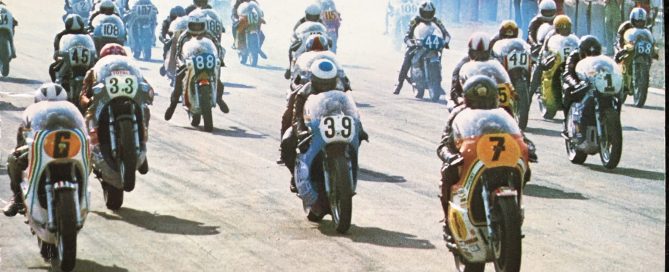
There is nowhere better in the World than Le Mans to witness that undiluted explosion of sound and fury at the start of a MotoGP™ race. It just bounces off those towering legendary grandstands that dwarf the start and finish straight. When empty the noise is further amplified from the concrete terraces. Sunday was no exception as Jack Miller headed the growling pack of 300 bhp monsters into the fast right-hander before the Dunlop chicane. It all used to sound so different. Up to 34 years ago all you could hear was the patter of feet on tarmac when the flag dropped even at Le Mans

Thirty-eight years into the 73-year history of Grand Prix racing you had to start the race by pushing your bike to fire it into action ready for the battle that lay ahead.  From 50 to 500cc and even sidecars, it was the only way to join the fight. So many races were lost as a rider pushed, pushed and pushed to start his bike as his rivals disappeared over the horizon and out of sight. It all changed in 1987 when clutch starts were finally ratified starting at the Japanese Grand Prix at Suzuka, the opening round of the World Championship.

It was a very special event not only for the clutch starts. The first Japanese Grand Prix for 20 years and on a personal note the first time I went to Japan and the first time I ever witnessed a fax machine in action. At the time I forgot those first three memories. A fax machine that saved hours of typing out full results late into a Sunday night and could contain six different classes and sidecar passengers. It was a miracle!

Randy Mamola won that first 500cc race with clutch starts but Randy knew all about and had perfected the art of running and pushing. The Californian had already won ten 500cc Grands Prix before the change. In the 500cc class you either had to be a side saddler or jump on starter. The paddlers were confined to the smaller class

In the 50 and later 80cc classes and especially when the two-strokes took over, riders would propel themselves off the line sat on the bike. They would paddle and paddle with both legs and hope the engine would fire into action when they prayed they had enough speed to drop the clutch. It was a gamble that worked most times although failure meant the rider would have to jump off and push.

The classic method of starting especially in the four-stroke era in the bigger classes was side saddle. Riders would look more like royalty on a leisurely horse ride round their estate sitting side saddle. There was nothing leisurely about what happened when they dropped the clutch and the engine roared. They would cock their leg over the back of the saddle onto the footrests as they disappeared

The riders loved the downhill starts and nowhere better than Spa-Francorchamps in Belgium. From the start line it was downhill towards the legendary Eau Rouge corner at the bottom of the hill. Most people made good starts at Spa and none better than seven times World Champion Phil Read. My first trip to Spa was in 1974 and Read made the perfect start on the MV Agusta four-stroke with Giacomo Agostini leading the chasing pack on the two-stroke Yamaha. Spa may have been 14.100 kms long but just over four minutes later we first heard and then saw Read racing through the Ardennes forest to complete his first lap with not a single other rider in sight. Perfect start and race for Read who beat Ago by an incredible 72 seconds to win the race and eventually the World title.

It really was a case of the sound of silence until 1987 with just the patter of feet to signify a Grand Prix had actually started. Clutch starts certainly made life easier for riders. Like all changes it also had its disadvantages. Modern technology catches anybody who moves a centimetre before the lights change. Back in the pushing days a small step before the flag dropped would usually go unnoticed. Afterall, there was plenty of pushing ahead.
By |2021-05-20T08:23:28+00:00May 20th, 2021|Nick's Blog, Uncategorised|1 Comment

A long way from home

There is something special about Australian sportsmen and women. Perhaps performing so far from home makes them just that more determined to win and prepared to push to the limit and beyond. Grand Prix motorcycle racing is a prime example of the hardships they have overcome to win World Championships and Grands Prix for their country. It is also probably a reason they celebrate success a fair bit harder than most other nationalities. From that first Australian Grand Prix winner Ken Kavanagh in 1952 to Jack Miller’s win at Jerez last weekend you realise just what it means not only to the rider but the whole country.

Australian riders have always been prepared to follow their dreams and travel across the globe to race against the best in the world. They were not content to just read about or watch at the cinema Grand Prix racing in Europe. Instead, they made enormous sacrifices and, in some cases, the ultimate sacrifice, to find out for themselves just what it was all about.

Imagine making that 22,000km six-week sea journey from Australia to Europe to compete in the very first World Championship event at the 1949 TT races in the Isle of Man. That four-hour crossing from Liverpool to the Isle of Man across the bumpy Irish Sea must have seemed like a doddle for the three Australian riders, Eric McPherson, Harry Hinton and George Morrison, who flew the Australian flag 73 years ago not only at the TT but in that historic first season. Growing up I always thought how romantic it sounded. Far from home, travelling around Europe in a van to race motorcycle at legendary venues but it was a hand to mouth existence, especially for the non-European riders, but they continued to arrive

Hinton’s third place in the 1950 Dutch TT riding the Norton was their first podium finish. Two years later Ken Kavanagh became the first Australian winner with victory in the 350cc race at the Ulster Grand Prix. It took another four years for the first world title with Keith Campbell crowned the 1957 350cc World Champion riding the Italian Moto Guzzi machine. Tom Phillis made history four years later bringing Honda their first Grand Prix win in the 1961 125cc Spanish Grand Prix. He went on to bring Honda their first world title the same year but tragically lost his life at the 1962 TT races.

I remember watching Barry Smith winning the 1968 50cc TT race and a year later sitting spellbound witnessing Kel Carruthers jump the legendary Ballaugh Bridge on the mountain circuit riding the gloriously sounding four cylinder Benelli. Carruthers, who later became the mentor for the likes of Kenny Roberts to dominate European racing, went on to win the 250cc TT and the world title.

Twenty years later I was in the thick of the action when two Australian riders arrived to dominate the 500cc World Championships and change the whole direction of the sport back home. Wayne Gardner lived on fish and chips and slept in the back of his Austin 1800 car when he arrived in England in 1982. Five years later he became the first Australian 500cc World Champion, and the country went completely crazy. He was voted Australian Sportsman of the Year ahead of Wimbledon tennis champion Pat Cash. National television started to broadcast the races live and the magnificent Phillip Island circuit staged the first Australian Grand Prix.

Mick Doohan took over the handlebars in the nineties. I will never forget the Queenslander’s fight back after almost having his leg amputated following his Dutch TT crash in 1992. He returned to somehow compete in the final two Grands Prix of the year but could not prevent Wayne Rainey retaining his title by just four points. A fit Mick and Honda proved an unbeatable combination winning five consecutive 500cc titles between 1994 and 1999 before injury forced one of the sport’s true greats to retire

When I returned full time to the MotoGP™ paddock 21 years ago, I received so much help and encouragement from the aimable Jack Findlay, who was working for IRTA. In 1971, Jack became the first rider to win a 500cc Grand Prix on a two-stroke machine when he won the Ulster Grand Prix for Suzuki.

Garry McCoy and Chris Vermeulen certainly had contrasting styles but continued Australian MotoGP™ success until a young but so very fast Casey Stoner arrived in Europe. His parents sold up everything to bring their talented son to take on the world. They lived in a caravan in the cold, wet and windy north of England but their sacrifices were rewarded. Casey was something special. He brought Ducati their first premier class world title in 2007 and four years later regained the Championship on the factory Honda before retiring with his family to his farm back home.

Jack Miller’s Jerez victory was the 182nd time an Australian rider has stood on the top step of a Grand Prix podium. Three Australian legends have gone on to win the ultimate premier class prize, the 500cc or MotoGP™ World Championship. Jack’s Ducati win at Jerez has set him up to follow in their footsteps and, even more important, honour those pioneers who never made the long journey home.

By |2021-05-12T17:40:57+00:00May 12th, 2021|Nick's Blog, Uncategorised|1 Comment

A silent sunrise in Andalucia

As the orange ball of the sun rose majestically, lighting up the sky revealing the hills surrounding the Jerez de la Frontera-Angel Nieto circuit on Sunday, there was an eerie silence. It was 7.32 am on the morning of the Red Bull Grand Prix of Spain and never had the absence of those passionate and dedicated fans of this incredible sport been more poignant.

Who would ever forget arriving at the Jerez circuit in the darkness around 7 am to avoid the traffic problems the 100,000 plus crowd would always create? Slowly and gloriously the sky would start to lighten in the East accompanied by a cacophony of excitement, anticipation and partying in the darkness beyond.

From the media centre balcony, I would peer through the darkness across the paddock, which was already a hive of frenzied activity, to the far end of the circuit and the hillside surrounding the stadium section of this legendary venue overlooking the Angel Nieto and Peluqui right-hand corners.

As the sun slowly rose layer by layer of the hillside that the darkness had hidden was revealed. There were thousands of fans jammed or in some cases hanging onto the hillside and having the time of their lives. Music blared, dancing if you could find the space, banners fluttered, air horns trumpeted, and beer flowed warmed by the sunshine. All roads in Europe led south in the first week of May. This was Jerez, the start of the European MotoGP™ season and like all special days it had to be celebrated in true style. And it was.

If ever a single place typified what MotoGP™ was all about this is surely it. A barren hillside in Andalucia, a clear illustration of just why MotoGP™ is so way ahead of any other World Championship Motorsport series. Those fans on the Jerez hillside just summed up how we all feel about MotoGP™. The passion, excitement, pure joy and patriotism just erupts after a long winter and after watching the start of the season on screens a long way from home in Qatar, Argentina and Austin.

A hillside that was so capable of sucking a Spanish rider to victory and there has been plenty of them. A hillside that was not always the best behaved. Climbing over the barriers in 1996 to celebrate an Alex Criville victory over Mick Doohan when it was announced the battle was over but there was still a lap to go. A few plastic bottles did fly from their massed ranks when the World 500cc Champion Kenny Roberts retired in front of them.

The saddest aspect for those absent fans surely must be the performance being put on by the riders in the opening four rounds in all three classes. It is a remarkable show and both the riders, and the fans deserve each other. Hopefully, the long wait is almost over, and they will return before the end of the season. In the meantime, the riders just keep producing the goods. Last year I attended a football play off final at the legendary Wembley Stadium in London. A crowd of around 250 permitted in a stadium that seats 90,000 made for one of the most surreal sporting events I have ever visited. Hopefully, the end of such experiences is just a few laps away.

There may have been silence on the hillsides and grandstands surrounding Jerez on Sunday but if you had cocked an ear, you may have caught the sound of celebration on the wind thousands of kilometres away at Townville on the Queensland coast of Australia. What a win for Jack Miller in the MotoGP™ race. Spanish or not Jack and those fans would have celebrated together.

Be patient, those days will return. The wait will be worth it, the riders have made sure of that.

By |2021-05-06T08:55:40+00:00May 6th, 2021|Nick's Blog, Uncategorised|Comments Off on A silent sunrise in Andalucia

The kids are alright

A well-known football television pundit and international footballer famously once declared to millions of viewers that a certain top club would never win anything by playing ‘kids’ in their team. Within two years that club won the Champions League, Premier League and FA Cup. I wonder what he would have made of MotoGP™ now where the kids are doing even better than alright.

The average age of the three Grand Prix winners in Portimao last week was the youngest ever in the 73-year history of Grand Prix racing. I cannot help wondering how the riders can possibly get any younger and can those MotoGP™ bikes possibly go any quicker? The average age of the three Grand Prix winners in Portugal was just 19 years 289 days. Yes under 20 years old!

Not surprisingly Moto3™ sensation Pedro Acosta (Red Bull KTM Ajo) kept that average age to record levels. The rookie secured his second win of the season aged just 16 years 328 days. Moto2™ winner Raul Fernandez (Red Bull KTM Ajo) was 20 years 177 days old when he took the chequered flag in Portimao to win his third Grand Prix and first in his rookie Moto2™ season.

Frenchman Fabio Quartararo was positively the ‘old man’ with his second MotoGP™ victory of the season. The Monster Energy Yamaha rider took the lead in the World Championship aged 21 years 363 days.

The previous record was set at the 2014 Americas Grand Prix in Austin. Jack Miller (Ducati Lenovo Team) won Moto3™, Maverick Vinales (Monster Energy Yamaha MotoGP) Moto2™ and not surprisingly Marc Marquez (Repsol Honda Team) in MotoGP™. Their average age was 19 years 320 days.

So, what about the other end of the scale and the highest average age of the Grand Prix winners at one event. Sixty-eight years ago, in the 1953 Spanish Grand Prix at Montjuic Park in Barcelona, the average age of the three winners was 40 years 224 days which is more the double the average age in Portugal last week.

Italian Angelo Copeta grabbed his one and only 125 cc Grand Prix victory riding the MV Agusta when he was aged 34 years 163 days. Fellow Italian World Champion Enrico Lorenzetti won the 250-cc race riding the Moto Guzzi aged 42 years 273 days. The oldest of them all was Englishman Fergus Anderson who won the 500-cc race at the tender age of 44 years 237 days. Never was there a clearer indication of how the second world war robbed future Grand Prix winners of their adolescence. In 1953, the war had only ended eight years ago.

Can the average winner’s age possibly drop even further? The Worldwide competitions set up to bring youngsters into Grand Prix racing suggests it could. Could a 40-year-old rider ever win a MotoGP™ race? A little more unlikely, and so over to you Vale to shatter yet another record.


By |2021-04-28T21:08:52+00:00April 28th, 2021|Nick's Blog, Uncategorised|Comments Off on The kids are alright

Acosta chases history on Sunday, but not on a Bantam

It may be a long time ago, but I remember I only had one thing on my mind on my sixteenth birthday – how can I raise the princely sum of £15 to buy my first motorbike. My friend’s Dad was selling his 125cc Bantam and with some help from my parents, I was on the road.

On Sunday at Portimao in Portugal, a 16-year-old Spaniard will not be worrying about a BSA Bantam but concentrating on re-writing the 73-year-old Grand Prix history books and joining a very exclusive club. Pedro Acosta’s sensational victory in the second round of the Moto3™ World Championship in Qatar opened the doors for some record-breaking at round three on Sunday. That staggering first Grand Prix win when he decimated the field after having to start from pit lane came just a week after his second-place podium finish in Qatar on his Grand Prix debut. A win or even podium finish on Sunday will place the former Red Bull Rookies Champion in a very special place

If Acosta finishes in the top three in Portugal, he will be the youngest rider to open his career with three successive podiums. If the KTM rider wins the race in Portugal he will be the second youngest rider ever to take back-to-back wins, after Maverick Vinales.

In the 73-year history of Grand Prix racing, only four riders have finished on the podium in their first three Grand Prix starts:

In 1949, the first year of Grand Prix racing, Italian Arciso Artesian secured three successive podiums on his debut. The Gilera rider missed the opening round at the TT races in the Isle of Man, but then finished on the podium at Switzerland, Dutch TT and Belgium.

A year later British Norton rider Geoff Duke finished second in the 350cc TT, won the 500cc TT and then was third in the 350cc race in Belgium at Spa Francorchamps. Duke was a sporting hero in post-war Britain winning six World titles for Norton and Gilera

In 1991 the bubbly bespectacled Noboru Ueda was on the podium at the opening three 125cc Grands Prix. In an explosive start to his World Championship career the Japanese Honda rider won the opening round at Suzuka, finished third behind Loris Capirossi and Fausto Gresini at the Eastern Creek in Australia and won again at the opening European round in Jerez. Nobby went on to win 11 more Grands Prix but never a World title. He was second in 1994 and in 1997. In true Acosta style, although not from pit lane, Ueda won a race starting from the back of the grid. At the 1997 Japanese Grand Prix he had qualified on pole, but on the sighting lap noticed the wind direction has changed so he called into the pits to change the gearing. This resulted in him starting from the back of the grid. He won the race which was the second round of the Championship. A young Valentino Rossi won the opening round in Malaysia and then the third and fourth rounds in Jerez and Mugello.

In 1996 the late great Daijiro Kato finished third as a wild card entry in the 250cc Grand Prix at Suzuka in the third round of the Championship. He returned as a wild card entry to win the race for Honda a year later and then in 1998. Despite the gaps, these were Kato’s first three Grand Prix appearances. He went on to win 15 more Grands Prix and the 250cc World title in 2001 before his tragic death in 2003.

So already Acosta had joined an elite band of Grand Prix legends. My beloved Bantam only once touched 55 mph racing down Cumnor Hill. I don’t think the Spanish teenager would have been that impressed.

By |2021-04-15T07:15:26+00:00April 15th, 2021|Nick's Blog, Uncategorised|1 Comment

Murray Walker, Lennon and Jagger

My teenage mates in the sixties thought I was sad. We would cycle down to the Russell Acott record store on Oxford High Street. After a sly fag behind the Mitre hotel, they would be listening to new 33-inch vinal albums such as Sgt Pepper’s Lonely Hearts Club Band from the Beatles or Aftermath from the Rolling Stones. I would be at the other end of the shop seeking out the Stanley Schofield long-player recordings from the TT races in the Isle of Man.

They would enthuse over the voices of John Lennon and Mick Jagger while I would be just as excited listening to the voice of Murray Walker. While Lennon and Jagger would tell us about Lucy in the Sky with Diamonds or Mothers Little Helper, I was equally spellbound listening to Murray’s dulcet tones. No drums or guitars in the background just the wail of Mike Hailwood’s Honda six as he raced between the walls and houses on Bray Hill at the start of the TT mountain circuit.

Murray’s voice was my link to a world I could only dream about. The World of Grand Prix motorcycle racing and the TT races. Whether it be from those iconic broadcasts on BBC radio’s Light Programme from the Isle of Man or those well-worn Stanley Scofield records. Murray was the joint commentator with his father Graham who was a TT and Ulster Grand Prix winner. The voice that became legendary throughout the world boomed out from our imposing radio in the dining room, filling the house with the exploits of Duke, Surtees and Hailwood.

Once we managed to ‘borrow’ the speakers from my friend’s parents record player and hide them in the hedge next to the bus stop. People waiting to catch the number 67 to work in Oxford were confused. Murray in full cry and volume describing the start of a TT race on the Glencrutchery road was not what they were expecting at 8.30 in the morning.

My favourite record was that memorable 1967 TT battle between Hailwood and Giacomo Agostini. I can still close my eyes and hear Murray describing Hailwood racing into the pits on the 500 cc Honda four and screaming for a hammer to bash the loose throttle back on the handlebars. Hailwood re-joined the race and won.

When I crossed the road for six years to work in Formula One, Murray was a legend. He was the voice of Formula One known throughout the world. He helped me so much in my new adventure. There was nothing we enjoyed more over a coffee in the F1 paddock than discussing and reminiscing about Grand Prix motorcycle racing and his beloved TT.

His Formula One commentaries are stuff of legends. His sheer enthusiasm and passion for the sport he loved so much came in a loud cacophony of sound, joy and sometimes wonderful gaffs.

God bless you Murray – you were voice for all of us to try and follow. None of us have ever got close.

By |2021-03-21T16:37:34+00:00March 21st, 2021|Nick's Blog, Uncategorised|2 Comments

Criville waited seven years to unlock the door

Just 168 hours in seven breathless days separated Joan Mir’s first MotoGP™ victory from that World Championship conquest on Sunday. The rider that produced the key to unlock the door to Spanish domination of the premier class had to wait so much longer. A gap of over seven long years separated Alex Criville’s first 500cc Grand Prix win to the title.

I am sure it will not surprise you that I had problems pronouncing Alex Criville’s surname when he brought Spain their first-ever Grand Prix victory in the premier class. I had just about got it right 21 years ago when the very same Criville produced the key to unlock the door to Spanish MotoGP™ World Champions with their first-ever premier class title in 1999

A certain Valentino Rossi stood in their way for the following decade but then the floodgates opened for the likes of Jorge Lorenzo, Marc Marquez and, on Sunday, the mighty impressive Joan Mir.

We always admired the brilliance of Spanish riders in the smaller classes but even multiple World Champions Angel Nieto and Sito Pons struggled in the premier class and did not stay around for long. Then came the 1992 Dutch TT in Assen. Crashes had ruled out the likes of Rainey, Doohan, Schwantz and Lawson. Alex Criville was on hand to win a fantastic three-way battle over John Kocinski and Alex Barros.

Mick Doohan then took over with five straight 500cc World Championships and Alex had to wait another three years just for his next victory. Six more followed over the next three years but the first European Grand Prix of the season in 1999 had a familiar sense of déjà vu to this year. Five-time World Champion and Criville’s teammate Doohan crashed at turn four at Jerez and was ruled out for the remainder of the season. It was the end of Mick’s amazing career, although we did not know at the time. Mick’s crash came on the exit to the very same bend that brought Marc Marquez’s short season to a premature halt this year. Alex went onto win six Grands Prix that year including that Jerez race

Like Mir, he clinched the title at the penultimate round at Rio in Brazil. Both races caused television producers a real headache. The race in Rio turned into a breathtaking last lap battle between Norick Abe, Max Biaggi and Kenny Roberts. Criville’s sixth place would be enough to bring Spain that first title. What pictures do you show? They faced the same problem on Sunday as Franco Morbidelli and Jack Miller fought a ferocious last lap duel to the chequered flag. Mir’s seventh place going into the last lap at Valencia was enough to bring him the title. The television producers were spot on and we got a great view of both Morbidelli’s third win of the season and Mir’s World Championship victory.

Both Criville and Mir had won World titles before arriving in the premier class. Alex was the 1989 125cc World Champion but had to wait ten years before that 500cc crown. Joan only had to wait three years between his Moto3™ World title and being crowned MotoGP™ King.

So happy 21st birthday Spanish motorcycle racing and just one more similarity. I had as many problems pronouncing Joan Mir’s first name when he won that Moto3™ World title as I did Criville’s surname in Assen 28 years ago.


By |2020-11-18T20:14:43+00:00November 18th, 2020|News and Events, Nick's Blog, Uncategorised|Comments Off on Criville waited seven years to unlock the door

Keep an eye on those T-Shirts

The Suzuki Ecstar team will leave no stone unturned in the next seven days. In the garage they will lovingly be preparing the GSX – RR Suzuki that could bring them their first premier class world title for two decades. Behind the scenes, World Championship winning press conferences and television interviews have to be planned. Videos, photographs and written copy written for immediate release on Sunday afternoon will be prepared and checked while the obligatory World Champion T-Shirts have been designed, printed and dispatched.

For the first time in this incredible season, Joan Mir could and has a real chance of clinching the ultimate prize at the penultimate round in Valencia. Following that maiden premier class win in Valencia, he holds a precious 37-point lead in the Championship. The 23-year-old Spaniard does not need reminding of what he needs to do on the tarmac of the Ricardo Tormo circuit, but he will not need or want to know what happens if he wins the ultimate prize. He can worry about all that afterwards

The only problem for the team, and let us be honest it is a decent one, is that Mir’s team-mate Alex Rins could still win the title, although not on Sunday. Together with Fabio Quartararo, he is 37 points behind. With 50 points up for grabs in the final two races it could still be decided at the final round in Portugal. At least it gives the team time to prepare for both eventualities which was not the case for the Monster Yamaha team in that controversial finale at Valencia five years ago. Valentino Rossi arrived in the caldron of frenzied excitement and toxicity with a seven-point lead but having to start from the back of the grid after the shenanigans in Malaysia. The team, which was divided, had to prepare for both eventualities. Lorenzo won the title and wore the T-Shirt.

I was involved in two very different World Championship winning, planning and celebrations. In 1987 the BBC sent me to Goiania in Brazil for the penultimate round of the 500cc World Championship.  Wayne Gardner had built up a special rapport with their listeners and had a great chance of clinching the title. Part of the deal for my expenses paid trip was that they would get the first live interview with the new World Champion. On arrival at the circuit, I discovered the commentary position was opposite the podium and pit lane in the very public grandstand. There was only one man to help me and he did not let me down. The Chief of Police in Goiania assured me that all would be OK. When race winner and new World Champion Wayne Gardner wearing the World Champion T-Shirt over his leathers soaked in champagne arrived at my commentary position surrounded by six fully armed policemen in full uniform I believed him

It was a very different story five years later at Kyalami in South Africa. A truly battered Mick Doohan arrived hanging onto a precious two-point lead over Wayne Rainey at the final round of the 1992 500cc World title. Never have I witnessed somebody so determined to overcome pain and physical weakness to win his first World title and we owed it to Mick to be prepared. Rothmans Honda Press folders and photographs were prepared for the media at the circuit and thousands back in England to be dispatched throughout the world as soon as the race ended – hardly any social media in those days. The 1992 World Champion T-Shirts were prepared, and worldwide interviews planned.  It was a sad sight after the race watching the folders being burnt and the T-Shirts cut up when Mick failed by four points to clinch the title, he went onto win five times. Years after, a Greek journalist was spotted wearing a 1992 Mick Doohan World Champion T-Shirt. How that happened I have no idea.

I am sure Suzuki are prepared for every eventuality. It is a fantastic situation to be in but keep an eye on those T-Shirts.

By |2020-11-12T09:01:16+00:00November 12th, 2020|News and Events, Nick's Blog, Uncategorised|Comments Off on Keep an eye on those T-Shirts

We can only dream – Marquez Vs Rea

It was the day that two great World Champions performed on the same stage but unfortunately not in the same race.

Watching Alex Marquez’s superb performance on Sunday riding that that so distinctively branded Repsol Honda brought back memories of MotorLand Aragon eight years ago

Honestly, little did I prophesise that those two riders would go on to totally dominate their respective chosen paths after seeing them compete on that September afternoon in the Spanish sunshine.  It was the closest that MotoGP World Champion Marc Marquez and World Superbike Champion Jonathan Rea came to the head to the head of all confrontations in a World Championship showdown.

On Saturday Rea secured that record-breaking sixth successive World Superbike title at the final round in Estoril. The Northern Ireland Kawasaki rider is just one short of 100 victories in the Championship. Eight years ago, Jonathan was drafted into the Repsol Honda team to replace the injured World Champion Casey Stoner and partner Dani Pedrosa. It was a big ask but in just two MotoGP appearances he displayed so much ability to make his record-breaking World Superbike career perhaps not such a great surprise.

After finishing eighth in his first race on the Repsol Honda at Misano won by Jorge Lorenzo he came to Aragon. In the 23-lap race in his second, and as it turned out final MotoGP™ ride, Rea finished seventh one place in front of Valentino Rossi in the race won by his team-mate, Pedrosa. That was that. Casey returned to finish the season and then retire. A certain Marc Marquez replaced him, and the rest is history for both riders

Marquez sat at home on Sunday cheering on his younger brother to second place in Aragon, his second successive podium finish. Marc still recovering from those injuries sustained in the opening round in Jerez, competed in a crucial Moto2™ race at Aragon on the same afternoon before Rea made that final MotoGP™ appearance

It was a crucial 21 lap race as he closed in on the Moto2™ World Championship before replacing Stoner in MotoGP™ the next year. Marquez picked up 20 vital points after finishing second behind his great rival Pol Espargaro. Third place in the race went to Scott Redding who ironically finished second to Rea in this year’s World Superbike contest. Marquez clinched the title to add to his 125cc crown and moved on smash all the records that MotoGP™ could throw at him. Six World titles and 56 Grand Prix wins in a style we have never witnessed before.

I am sure there is still more to come from both Champions but sadly not in conflict with each other. How would it have turned out? Marquez with eight World titles and 82 Grand Prix wins versus Rea with six World titles and 99 race victories.

 Unfortunately, we will never find out who would have won the battle of the ‘sixers’ but we can always dream.

By |2020-10-21T20:01:48+00:00October 21st, 2020|Uncategorised|Comments Off on We can only dream – Marquez Vs Rea

Hopefully the rain will have stopped in 2021

Monsoon like rain totally obliterated the signs to the Silverstone circuit as we drove along the A43 last Thursday afternoon. It would have been a washed-out day before the start of the British Grand Prix in normal circumstances. Silverstone looked desolate, empty and very wet. For the first time since the World Championship started in 1949 there was no British round of the World Championship. Similar monsoon conditions two years ago caused the cancellation of race day, but the British Grand Prix was on that original schedule and practice and qualifying went ahead. Only Britain and Holland had staged a World Championship event every year since 1949 and both had to be cancelled this year in the current pandemic crisis.

In many ways Silverstone, which hosted the first ever Formula One World Championship race in 1949, spearheaded the two wheels safety revolution in the seventies. The road-based circuits that had been the very foundation of those early World Championship pioneering days were just too dangerous for motorcycles that were getting so much faster and more sophisticated. The most famous circuit of them all the 60.721 kms TT mountain circuit on the Isle of Man had staged that first World Championship race in 1949 but in 1976 it ended an era and hosted its last World Championship event. Top riders including multi TT winner and World Champion Giacomo Agostini boycotted the Isle of Man because they thought it was just too dangerous while National Federations like Spain banned their riders from competing.

On August 14th, 1977 Silverstone took over the World Championship status and hosted the British Grand Prix for the first time. It was a major chapter in the history of the sport which just had to happen. A purpose-built safer circuit replacing the legendary road circuit. Others were soon to follow suite. Rijeka in Yugoslavia, Brno in Czechoslovakia, the Nürburgring and the Sachsenring in Germany realised were the future lay. They built new circuits to ensure their futures as World Championship venues while never forgetting the exploits of the riders and teams that had established the very foundations of modern day MotoGP racing with their skill, bravery and in some cases their lives.

It was so close to being the prefect start for Silverstone with a British winner in the 500-cc race. Steve Parrish led the way with a handful of laps remaining urged on by the pit board ‘Gas it Wanker’ held out by his great friend and World Champion Barry Sheene but then a few spots of that dreaded Silverstone rain arrived. Parrish lost the front end of his Suzuki and crashed at Copse corner. Another British Suzuki rider John Williams took the lead then crashed and American Pat Hennen deservedly won the historic race. It was Hennen’s second grand prix win but ironically his career came to an end when injuries forced him to retire after crashing at the now non-Championship TT in the Isle of Man a year later.

Two years later Silverstone staged a 500-cc race that is still talked about today. The BBC televised the race live with the legendary Murray Walker on the microphone and Kenny Roberts and Barry Sheene produced a battle that had the whole country mesmerised. Twenty-eight laps of pure undiluted magic. Constant overtaking, two fingered salutes and a Roberts victory by 0.03 s as Sheene tried to ride round the outside of him on the grass at the 200 kph Woodcote corner at the chequered flag.

That was that as far as a British rider winning the premier class race at his home grand prix. There have been some brave attempts by the likes of Ron Haslam and more recently Cal Crutchlow at Silverstone and Niall Mackenzie and Carl Fogarty when the British Grand Prix switched to Donington Park between 1987 and 2009 but no winners for the patriotic British crowd to celebrate.

We cannot wait for Silverstone, along with Assen, to return next year and hopefully it will have stopped raining by then.

By |2020-09-03T08:25:30+00:00September 3rd, 2020|Uncategorised|Comments Off on Hopefully the rain will have stopped in 2021
Go to Top